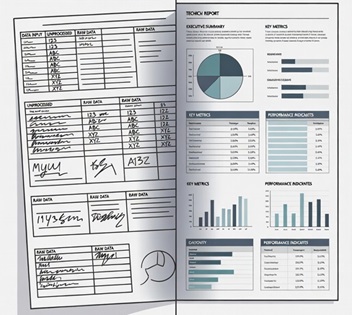
If you work in firearm testing or quality engineering, you already know the problem. The data exists. The insights are in there somewhere. But between raw outputs, free-form field entries, manual report compilation, and the next test already queued up, the time to actually interpret that data keeps getting crowded out by the work of just managing it.
AI will not replace the experienced engineer who knows what the data means. It will, however, handle a substantial portion of the work that keeps getting in the way of that person doing their actual job.
Here is how it works in practice, where it adds the most value in a testing environment, and where you still need to keep a human hand on the wheel.
Where AI Earns Its Place in a Test Environment Link to heading
The use cases that matter most in a testing or quality engineering context are not the headline ones you see in tech coverage. They are quieter and more specific, but the time savings are real.
-
Processing complex test data. My own turning point came when my counterpart test engineer and I were trying to find a way to process a large and particularly messy dataset from a new system. Excel had been the go-to for years and VBA had served us well, but this dataset was a different level of complexity. The timeline was tightening daily. We took the plunge into our first “vibe coding” project, using AI to collaboratively write and troubleshoot the processing software in a way that neither of us could have done as quickly alone. What would have taken six to eight weeks was done, validated, and launched in one and a half weeks. That is not a marginal improvement.
-
Cleaning free-form field data. Anyone who has tried to Pareto data that lives in free-form text fields knows exactly how much time disappears into that work. AI dramatically compresses that cleanup timeline, which means the engineer’s time goes toward interpretation rather than preparation. It can then help build a cleaner data entry tool for the team going forward, with guardrails that keep new entries consistent from the start.
-
Writing and formatting documents. Training documents, work instructions, test reports. AI handles the time-consuming structural and formatting work while the engineer focuses on the content that requires actual expertise to get right.
-
Building custom software solutions. This is where the shift becomes genuinely significant for small teams. Rather than waiting on an internal development queue or compromising with an off-the-shelf platform that mostly fits your needs, a test team can now build tools tailored exactly to how their testing is actually conducted. The team that understands the problem builds the solution. Round counts, stoppages, lubrication intervals, accessory configurations: tracked and reported in the format the team needs, not the format some SaaS product decided on.
Where to Be Careful Link to heading
The efficiency gains are real, but a few discipline points matter, particularly in a professional testing environment.
AI is an assistant, not a decision-maker. The engineer with domain knowledge still owns every conclusion. AI reduces the labor of getting to the analysis. It does not replace the judgment required to interpret it correctly.
Data security is not optional. Do not put confidential data, proprietary test results, or customer information into a public AI system. Treat any data you upload as potentially visible and act accordingly. For organizations with data handling obligations, this is not a gray area.
Verify the outputs. AI-generated code and documents need to be reviewed by someone who understands what correct looks like. The speed advantage disappears quickly if errors get downstream before anyone catches them.
The Practical Takeaway Link to heading
The question is not whether AI belongs in a professional testing workflow. For teams managing large data volumes, tight timelines, and limited development resources, the answer is already yes. The more useful question is where to start.
Start with the task that is currently burning the most time without adding the most value. For most test engineers, that is data cleanup or report generation. Take one of those workflows, describe what you need clearly to an AI tool, and iterate. The learning curve is shorter than it looks. In my own case I went from skeptical to a daily user in around 3 months.
Technology is evolving faster than most organizations can formally adopt it. The engineers and teams that figure out where it genuinely helps and build those habits now will have a meaningful head start.
If you are working through how to apply these tools in a firearm testing or quality engineering context, reach out via the contact page. I am glad to talk through specific use cases and what has worked in practice.