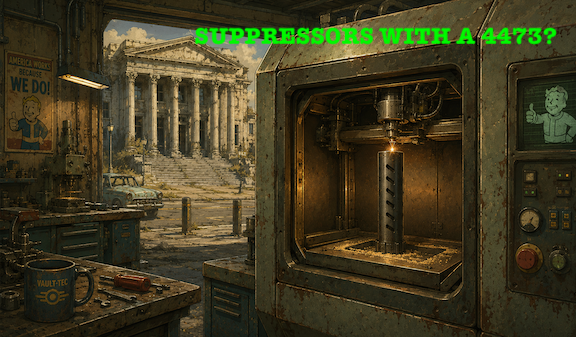
The federal judge in the Northern District of Texas, in Jensen v. ATF, gave the government until August 12th to appeal his ruling that portions of the National Firearms Act (NFA) are unconstitutional. That ruling struck down the registration and tax scheme that has applied to suppressors, short barreled rifles, and short barreled shotguns since 1934. It’s worth being precise here: these items haven’t been reclassified as non-NFA firearms, it’s the registration and tax requirements around them that were struck down. The deadline for the government to appeal has come and gone with no action, and the injunction is now in effect, but only for the plaintiffs and the members of the plaintiff organizations in the case and not the general public yet. For that group, suppressors and short barreled rifles are now being sold without the NFA registration wait and with just a simple 4473. What does this mean for the rest of us watching from outside that group, waiting for this to reach the broader market? I’ll leave the legal discussion to the myriad sources that will be covering this topic with more authority than I can bring. What will change, as this plays out, is the rate of new development in the market.
Why the NFA stifled development Link to heading
The NFA has placed a heavy burden on both consumers and manufacturers. Serialized firearms are already far more heavily regulated than many other products, but NFA items bring a whole new level of burden on paperwork that must be submitted often and on time for all of the right reasons. Any slip-up could be very costly to the business and land you in prison.
For the consumer, until January 1, 2026, each NFA item had meant a $200 tax for the simple fact of owning it. A burdensome set of paperwork was also placed on the consumer, with a duty to notify the government any time the item’s address changed, and for short barreled rifles and shotguns specifically, a requirement to get approval before crossing state lines with the item. Suppressors were actually exempt from that interstate travel approval requirement, though the notification and tax stamp obligations still applied to them. Just as much of a burden for many people as the $200 tax were the wait times, which have varied significantly over the years and at times stretched past a year to process the paperwork and allow you to take home the product you purchased.
All of this red tape, headache, and risk has caused an environment that stopped many manufacturers from starting a business in this area while simultaneously keeping consumers, who would otherwise want these products, out of the market due to red tape. The combination of producers staying out of the market due to legislation and artificially low demand due to the complexity of ownership has led to a stifled market for suppressors specifically.
What the future may hold Link to heading
The initial ruling is still a bit complex and only applies to the plaintiffs and their customers today, but this is a step towards these burdensome regulations finally being removed. With the removal of the NFA regulations of suppressor and SBRs, there is likely to be a flood of demand for the products on the market already today. Once the initial demand is caught up however, this could well mean a huge influx of capital into businesses that have been dealing in NFA products that can now be re-invested for more innovation into their technologies. It is far easier for a company to invest heavily in innovation when there is real customer demand for the products created.
Also likely to come is a flood of new manufacturers. With the per-item tax and registration wait gone, any company that can handle the typical burden of an FFL, along with the Special Occupational Tax status still required of NFA manufacturers, can start producing suppressors and SBRs without the added delay that used to come with every unit. I would fully expect lots of new names to pop up with new products to offer, some will be good and some will be mediocre, but these people are now free to compete in a far more open market than ever before.
Look at the number of new suppressor products that have appeared just since January 1, 2026 when the $200 tax was eliminated. I don’t have exact figures, but I know from watching product launches that many established firearm makers have now entered the suppressor market and the industry also added many new suppressor focused manufacturers. If the elimination of the tax stamp has given this much new life to the industry, just think of the innovation to come when these products only require a 4473.
The force multiplier Link to heading
One more factor that will help spur new amazing development is 3d metal printing. If you follow Jay’s reviews at Pew Science (pewscience.com) you’ll notice that a large majority of the top performing suppressors are 3d printed. This is because 3d printing allows very complex geometries to be produced in ways that were unthinkable with traditional machining. Also with 3d printing comes the ability to make a single test piece in a way that is actually economical. Asking a machine shop to set up and run 1 part is a very costly prospect due to the effort of getting a machine ready to run that single part, but with 3d printing the setup is just loading the necessary file.
Combine the power of 3d printing with the removal of NFA item registration and we are due for a shift in market innovation that has never been seen in this space. With increased consumer demand combining with advanced manufacturing techniques that allow producers to try new ideas at a reasonable cost, we can expect to see a step function in the level of suppressor technology.
What to do right now Link to heading
A simple answer here. If you have the ability to buy suppressors, SBRs, or SBSs on a simple 4473 then BUY, BUY, BUY! Let’s all hope this is the beginning of better times and tons of innovation.
Stay tuned for the flood of new products. Sure there will be some duds, but I am certainly excited to watch the innovation in this new environment! If you’re new to this space in the market and need a little advice on tailoring a test program to suppressor, then reach out and let’s talk!