What is nitriding Link to heading
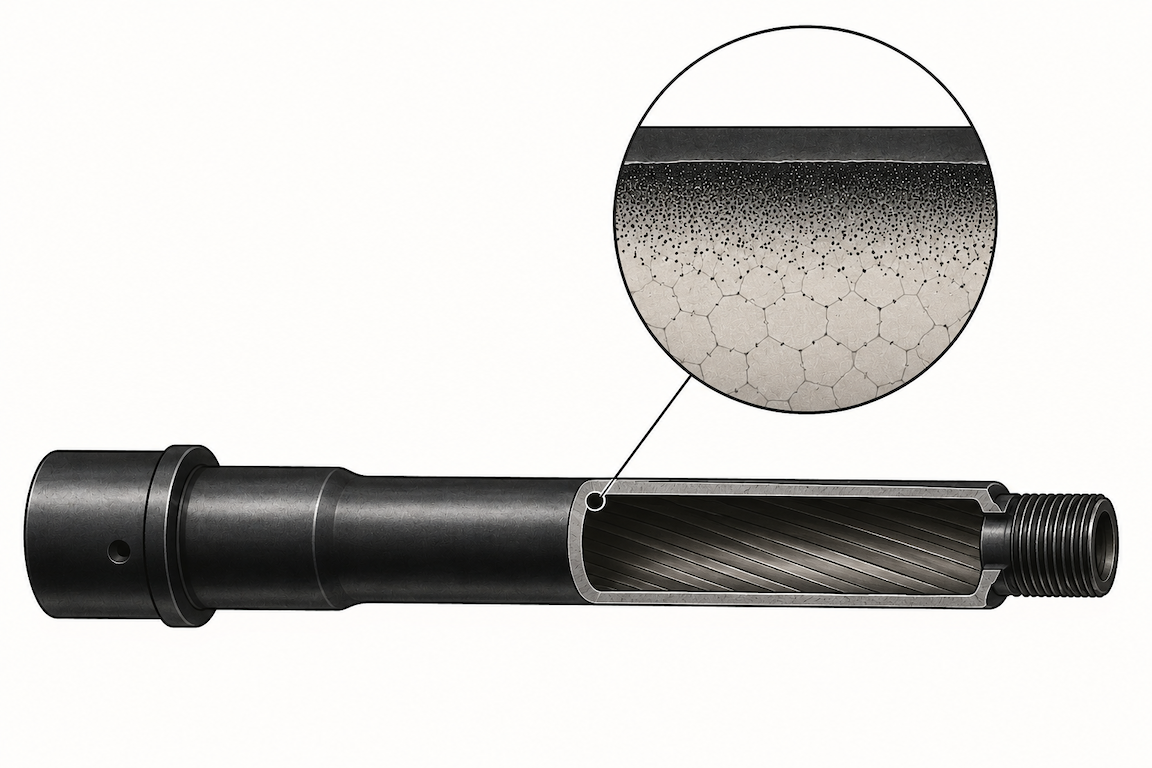
If I’m going to make a case to you that nitrided barrels are the current optimal solution for most consumers, then we should first discuss what nitriding is. In basic terms Nitriding is a process that diffuses nitrogen into steel parts. This nitrogen diffusion creates a case hardened layer that provides very good wear resistance and the process typically also includes an oxidation step that helps create some corrosion resistance.
Just enough chemistry Link to heading
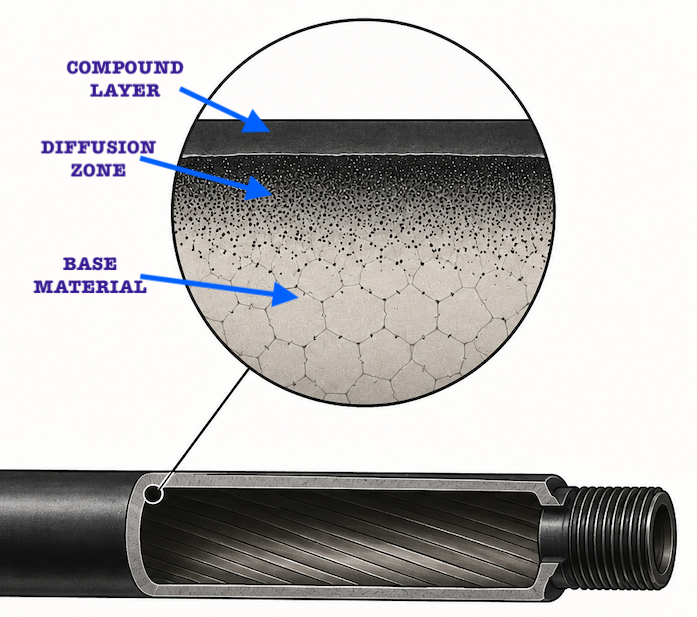
The nitriding process is carried out by heating a ferrous metal to a temperature where it can readily diffuse nitrogen into the surface. With the material at this temperature, nitrogen containing chemicals (typically ammonia for the gas process and cyanide salts for the salt bath process) are introduced. The nitrogen decomposes from the chemical used in the process and diffuses into the steel. This produces a very hard, but thin, outer layer typically referred to as the compound or white layer. This hard shell is a non-metallic phase of iron and nitrogen and is typically less than 10 microns thick.
Beneath this compound layer is the nitrogen diffusion zone where the material has increased hardness of the base material, but is less brittle than the compound layer. This zone is normally in the 20-40 micron thickness range depending on the process. It appears as a dark section between the compound layer and the base material when viewed at high magnification.
Under the diffusion zone is the base material that we started with. This is where our first big caution comes in. The nitriding process occurs at a temperature that is within the annealing zone of most steels. It is very important to find a combination of heat treat and nitriding parameters that does not let the core hardness of the material drop too far during nitriding.
The following diagram is a simplification that I will use here for illustration, but it gives the basic concept of how the nitriding is composed through the material.
Nitride as a barrel finish Link to heading
In the firearm market today, there are a handful of common finishes/treatments. They are broadly:
- Phosphate (there are a few variations of this)
- Chrome lined (normally phosphate outside with a chrome lined bore)
- Stainless steel with no additional treatment
- Bluing
- Nitriding
Let’s briefly touch on each of these to see the benefits and drawbacks.
Phosphate (and its variants) Link to heading
What is it Link to heading
Phosphate is a chemical treatment that alters the material at the surface of the barrel and creates a porous surface. This converted surface is only on the outer layer and is an alteration of the barrel steel, not an applied extra coating.
Advantages Link to heading
One big advantage is that the porous surface has very good oil retention and, as long as oil stays applied, it helps resist corrosion. This finish has also historically been used for its matte appearance which reduces glare (a plus for military applications), as well as some level of wear resistance.
Disadvantages Link to heading
The coating is only corrosion resistant when oil stays applied, the finish without oil is not corrosion resistant. Since barrels tend to get hot enough to burn off oil, this can be an issue. The increased wear resistance is also minimal in comparison to other choices.
Chrome lining Link to heading

What is it Link to heading
A hard chrome layer is applied to the inner bore of the barrel. This is done through an electroplating process where the material is added on top of the existing surface.
Advantages Link to heading
A chrome lined barrel has the most wear resistance of any barrel treatment listed here. Chrome is able to withstand high heat and the incredibly hard surface resists wear very well. These reasons are why many machine gun barrels are normally chrome lined. Chrome also resists corrosion well.
Disadvantages Link to heading
From the advantages section, chrome almost sounds too good to be true. There is a tradeoff though, there are no free lunches! Because chrome lining is a material additive process, any process variation (process variation is always present) will cause dimensional differences through the length of the bore. These dimensional differences will create accuracy loss depending on the severity, and this can and will differ from barrel to barrel. Great barrel shops can reduce this variability to an extent that most shooters won’t notice, but the risk is always there. There is a reason that the military allows the M4 accuracy to be as high as 4 MOA, they are willing to trade some accuracy for better full-auto durability. The other disadvantage is cost. Since chrome is hard to do well, skilled vendors don’t come cheap.
Stainless steel Link to heading
What is it Link to heading
Stainless steel is steel with a higher amount of chromium compared to other steels. This makes it more resistant to corrosion without any secondary process.
Advantages Link to heading
Stainless steel has two main advantages. The stainless portion means that it has some corrosion resistance without any secondary process. Barrel manufacturers also find certain stainless steel types to be very predictable in how they machine. This means that a very consistent product can be produced which is great for accuracy.
Disadvantages Link to heading
Stainless steel does not hold up to high heat as well as typical carbon steel alternatives. For high volume shooters, especially those getting their barrels hot, the service life will be less than other options due to increased wear. Secondly if you are military or LE and visual signature matters, then stainless will be a bright shiny beacon. Another quirk of stainless stell is that steels like 410 are difficult to machine because they don’t produce chips while 416 series has added sulpher to aid machinability but comes with added brittleness due to that sulpher. This makes the predictable machinability a plus and minus at the same time.
Bluing Link to heading
What it is Link to heading
Bluing is one of the oldest processes for increasing corrosion resistance. The process creates a thin layer of iron oxide (a controlled type of rust) that helps resist harmful corrosion.
Advantages Link to heading
Bluing gives a blue/black color to the gun and helps prevent corrosion (oil is still required).
Disadvantages Link to heading
Bluing does not enhance the material properties for longevity. There is no increased wear resistance, so the barrel will be dependent on the base material properties.
Nitriding Link to heading
What it is Link to heading
We’ve covered this in more detail above. Nitriding is a thermo-chemical process to diffuse nitrogen into the steel for increased wear properties.
Advantages Link to heading
The increased wear properties are a big advantage of nitriding. The case hardening effect makes the barrels last much longer. Since nitriding is a metal treatment and not an additive process, there is no concern of changing the internal bore dimensions during the process. This helps retain accuracy and consistency from barrel to barrel. The treatment can also offer a matte looking finish that has a solid level of corrosion resistance.
Disadvantages Link to heading
The biggest disadvantage of nitriding has to do with processing temperatures. If the process is not well designed, then it is very possible to mistakenly over anneal the parts and have a base material that is far too soft to be serviceable. This can normally be handled with process design, but care and validation are needed. Wear resistance is also second to chrome. Extremely harsh use at highly elevated temperatures will deteriorate the material faster than chrome lining.
The choice Link to heading
Given all of this, why do I make the argument that nitriding is the best choice for a majority of consumers?
- The process is common and cost effective. You can get a good price for a good consistent output from multiple vendors.
- The risk of accuracy loss is minimized. If you make the barrel well, then your finishing vendor won’t influence the accuracy potential of the barrel.
- Good wear resistance. Most consumers aren’t going to shoot out a nitride barrel super quick. There will always be exceptions to the rule, and depending on how hard super safeties and FRTs (Forced Reset Triggers) catch on, my opinion could change. For the shooting schedule of most consumers the wear resistance of nitride is sufficient.
- Good corrosion resistance. Nothing is perfect, but nitride has shown to be towards the top of the list on corrosion resistance