
The No Lube Myth Link to heading
Let’s address a myth that has been circulating long enough to cause real problems in the field. The claim is that little to no lubrication is the smart choice because oil will collect dirt and particulates and cause malfunctions. When I was new to firearms I was given this advice and believed it. The logic seems to hold up on the surface: dirt sticks to oil, so less oil means less dirt buildup in harsh or dirty environments.
Real testing does not support it.
Modern semi-automatic firearms rely on metal parts sliding against each other thousands of times over their service life. Oil is not a liability in that environment, it’s a requirement. Think of it the same way you think about the oil in your car. Engine oil allows components to move with reduced friction, manages heat, and turns black over time because it is doing its job: keeping contamination in suspension so it can be moved away from critical surfaces. Your firearm’s lubrication works the same way.
A dry gun does the opposite of what the myth promises. Carbon bakes onto metal surfaces, friction heat increases, and debris gets trapped between moving parts instead of being moved out of the way. Oil gives the gun resilience. The no-lube theory fails in practice because it misunderstands what oil is actually doing.
Why Your Gun Needs Oil to Function Link to heading
The most immediate benefit of lubrication is reduced friction. Without it, operating speeds slow down, and slower operating speeds mean the gun may not cycle fully. That leads to malfunctions. Increased friction also accelerates heat buildup and component wear, shortening the service life of parts that should last the life of the firearm.
Beyond friction, lubrication is a critical part of debris management. A liquid surface on operating components prevents carbon from adhering to metal. Carbon and dirt that go into suspension with the oil can be moved out of the way by sliding parts rather than accumulating and causing problems.
There is also corrosion protection to consider. A consistent oil film on metal surfaces prevents moisture from taking hold. Corrosion that is allowed to develop causes pitting that weakens material and changes surface geometry over time. Neither is recoverable without significant work.
What Lubrication Options Exist Link to heading
Most shooters put little thought into which lubricant they choose, but knowing the differences lets you select the right tool for the situation. There are three major categories:
| Type | Best Use Case | Pros/Cons |
|---|---|---|
| CLP (Cleaner, Lubricant, Preservative) | General maintenance and field cleaning. | Pro: Convenient for regular lubrication and quick cleans. Con: The solvent component causes the lubricant to evaporate, requiring more frequent reapplication. |
| Lube-Only (e.g., True Blue / Synthetics) | Lubrication after cleaning and long-term storage. | Pro: Stays in place longer since it is not a multi-tasking solution. Lubricates slightly better in dedicated use. Con: Not meant for cleaning, so this is a two-step process. |
| Grease | Higher heat applications or where you need lubrication to stay exactly in place. | Pro: Paste consistency means it stays where you apply it. Generally higher heat tolerance before degradation. Con: Easier to over-apply, which can cause its own problems. |
What specific product you use within each category is a more personal choice. Pay attention to viscosity, how quickly it burns off as the gun heats up, whether it gums up in your local climate, and if you are married then the odor is worth considering too (ask me how I know).
Practical Application Link to heading
You do not need to soak your gun in oil to get reliable function, though I will admit to reaching for a spray bottle for heavy applications from time to time. The gun itself will show you where oil is critical. Look for shiny spots where metal surfaces are contacting each other. Those wear marks are your lubrication map.
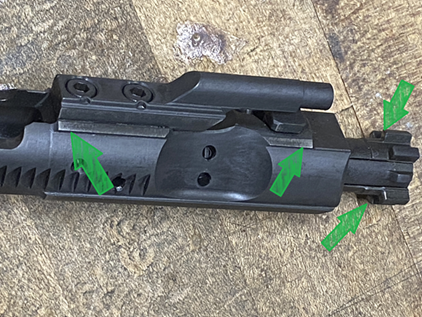
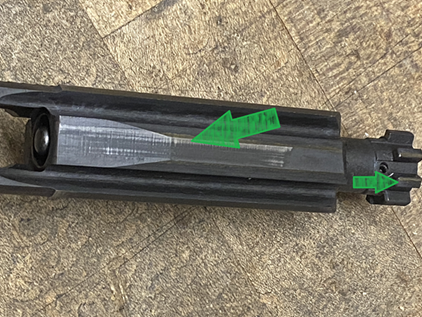
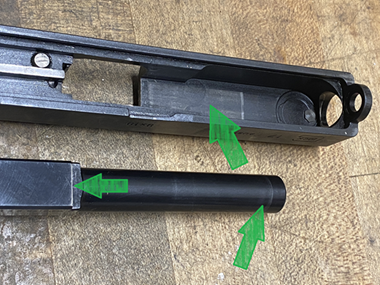
On an AR, focus on the BCG rails, the cam pin, the bolt lugs, and the shiny contact surfaces of the charging handle. On a pistol, common wear points are the slide rails, the outside diameter of the barrel, and the barrel locking surfaces. A light film across all metal surfaces is good practice beyond just the high-wear spots.
Lube Location Examples Link to heading
The AR bolt carrier group rides on the top and bottom rails and the wear indication will be visible. Lube the back of the bolt lugs as well since unlocking is a metal-on-metal sliding action.
The bottom of the AR bolt carrier re-cocks the hammer on every cycle.
On pistols, the top of the slide, the outside of the barrel, and the barrel lock surface will all show wear from their sliding contact.
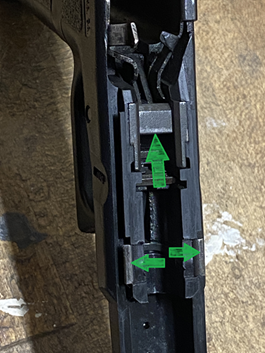
On the frame, pay close attention to the rail and the unlocking block.
A Note On Extreme Cold Link to heading
There is one genuine exception to the oil-always principle and it is worth knowing about. At extreme cold temperatures, oil can become viscous enough to prevent components from moving freely. The threshold from testing experience is around -60F. Below that point, standard lubricants become a liability rather than an asset.
If you are operating in conditions approaching that extreme, check the rated working temperature of whatever lubricant you are using. The only oil I have used that functions reliably at arctic temperatures is the military Lubricating Oil, Arctic Weapons (LAW). If you are below -45F and do not have access to LAW, experience has shown that running dry is genuinely the better option.
Questions About Your Lubrication Program? Link to heading
Whether you are sorting out your own maintenance routine or evaluating lubrication protocols for a professional testing or quality program, the principles here apply across both. If you have questions about a specific situation or want to discuss how lubrication fits into a broader reliability evaluation, reach out through the contact page.